165 miles of waterways
The City of Fort Lauderdale counts more than 165 miles of waterways and calls itself the "Venice of America." Canals, rivers and the Intracoastal Waterway wind through its neighborhoods. Source
Waterfront guide
A plain guide to Fort Lauderdale's waterways, bridges, seawalls and condo rules, each linked to its source.
The City of Fort Lauderdale counts more than 165 miles of waterways and calls itself the "Venice of America." Canals, rivers and the Intracoastal Waterway wind through its neighborhoods. Source
NOAA's Coast Pilot (October 2026 edition) places Fort Lauderdale at about Mile 1065 of the Intracoastal Waterway and calls the New River the main navigation channel in the area. The river is entered through two connecting channels, narrows at Tarpon Bend with strong currents and heavy traffic, and is a no-wake zone. Source
The Port Everglades entrance channel links the harbor to the Atlantic. The U.S. Army Corps of Engineers' 2025 fact sheet lists it at 45 feet deep, 500 feet wide and 5,100 feet long, with the inner channel 42 feet deep and 450 feet wide. Source
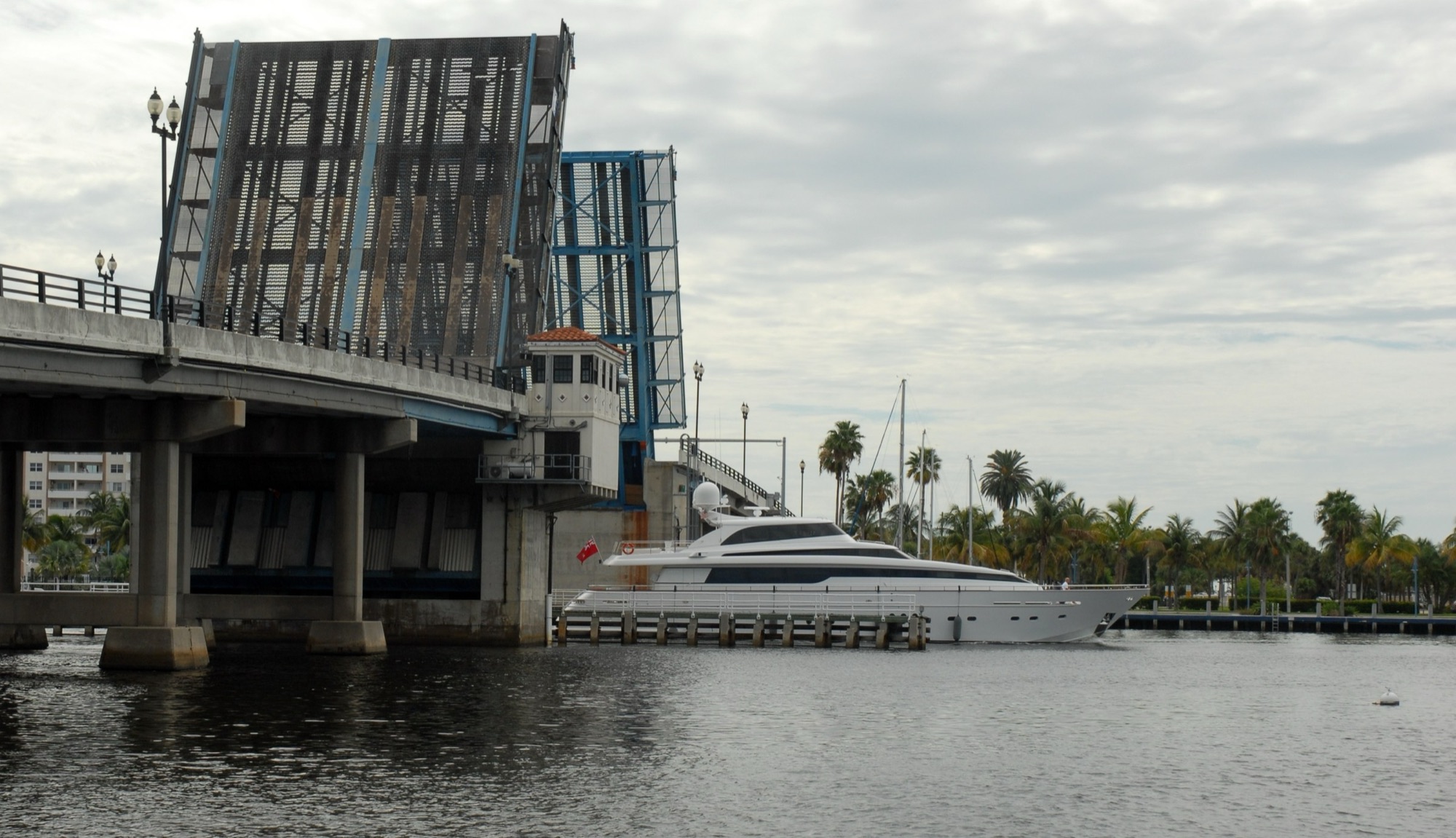
Every Intracoastal bridge from Commercial Boulevard to SE 17th Street is a bascule drawbridge. The Coast Pilot lists center clearances of 15 feet at Commercial, 22 at Oakland Park, 25 at Sunrise, a reported 24 at Las Olas and an authorized 55 at SE 17th Street. Some side waters sit behind low fixed spans, such as 10 feet on the Middle River at Sunrise Boulevard and 7 feet on the Mercedes River. A boat's air draft, its height above the waterline, decides whether it clears a closed drawbridge or must wait for an opening, and whether it can pass a fixed span at all. Source
Held every fall, the show reached its 67th year in 2026, running October 28 to November 1 at six locations including Bahia Mar, Pier Sixty-Six and the Broward County Convention Center. Organizers call it the largest in-water boat show in the world and report more than 100,000 attendees and over 1,300 vessels on display. Source
City Ordinance C-23-05, adopted March 23, 2023, created Section 47-19.13 of Fort Lauderdale's land development code. New or substantially repaired tidal flood barriers, a term that includes seawalls, generally need a top elevation of at least 5 feet NAVD88. Applications filed before January 1, 2035, may be permitted at 4 feet if the barrier is designed to reach 5 feet by January 1, 2050. Substantial repair generally means work along more than half the shoreline or costing more than half the structure's replacement value. Sale contracts in tidally influenced areas must carry a set disclosure. Confirm the current code for any specific property. Source
FEMA maps set each property's flood zone. In Fort Lauderdale, Zones A, AE, AH, AO and VE are Special Flood Hazard Areas, with VE adding storm-wave hazard, while Zones B, C and X lie outside the 1-percent annual chance floodplain. Flood insurance is required for most federally secured mortgages in those hazard areas, homeowner policies usually do not cover flooding, and National Flood Insurance Program coverage has a 30-day waiting period. Source
Under Section 553.899, Florida Statutes (2026), condominium and cooperative buildings three habitable stories or more need a milestone structural inspection by December 31 of the year they reach 30 years of age, then every 10 years. The local enforcement agency may set the first inspection at 25 years based on local conditions such as proximity to salt water. Source
The city's Building Safety Inspection Program, set under Broward County Board of Rules and Appeals Policy 05-05, covers buildings 25 years of age or older, with inspections every ten years after the first. Some buildings are exempt, including small residential buildings. Ask which rule and date apply to any building you are considering. Source
Under Section 718.112(2)(g), Florida Statutes (2026), a residential condominium association must have a structural integrity reserve study at least every 10 years for each building three habitable stories or higher. It covers items including the roof, structure, fireproofing, plumbing, electrical systems, waterproofing, and windows and exterior doors. For budgets adopted on or after December 31, 2024, owners generally may not vote to waive or reduce reserves for those items, with limited exceptions. Source
General information, not legal, insurance or engineering advice. Rules change, so confirm the details for a specific address with the city, the county and your own advisors.
Filter the sample homes by ocean access, or ask an advisor to run the route for your boat.